SBS Attendance Management Plan 2026
- Introduction and Guiding Principles
This document outlines the Attendance Management Plan for Snells Beach School, a semi-rural school serving the Mahurangi East area in the Mahurangi district (Rodney). This plan is designed to be a living document, reflecting our commitment to ensuring every student attends school regularly and engages in their learning. It aligns with the Ministry of Education’s requirements for mandatory Attendance Management Plans and the Stepped Attendance Response (STAR) framework, to guide when and how we respond to absences. In April 2024 the Government announced a regular attendance target of 80% of students to be present for more than 90% of the term by 2030.
Our guiding principles are:
- Whānau Partnership: We believe that strong, trusting relationships with our students, their families, and the wider community are the foundation of good attendance.
- Early Intervention: We will act promptly, compassionately and firmly when a student’s attendance begins to decline, addressing barriers before they become chronic issues.
- Community Collaboration: We will work with local agencies, community groups, and the Ministry of Education to provide holistic support for our students and their families.
- Celebration: We will celebrate and acknowledge good and improved attendance to reinforce its importance and value.
- Roles and Responsibilities
| Role | Responsibility |
| Board of Trustees
Principal / Senior Leadership |
Oversee the implementation and regular review of the AMP. • Ensure the plan is published on the school’s website annually. • Set an annual attendance target for the school.
Lead the implementation of the plan and provide professional development for staff. • Monitor school-wide attendance data and trends. • Act as the primary contact for moderate and chronic absence cases. • Liaise with the Ministry of Education Attendance Service and other support agencies. |
| Teachers
Admin Staff |
Record attendance accurately at the start of each morning and afternoon session. • Build strong relationships with students and whānau. • Act as the first point of contact for students with irregular absences.
Record and update absence notifications daily. • Contact parents/caregivers on the first day of an unexplained absence. • Maintain accurate contact details for all students |
| Whānau/Caregivers | Ensure their child attends school every day, unless they are unwell or attending a funeral/marriage/trialling another school (justifiable reasons – J Code ) • Notify the school promptly of any absence. • Work in partnership with the school to address any attendance concerns. • Ensure contact details are kept up to date. |
- Stepped Attendance Response (STAR) Framework
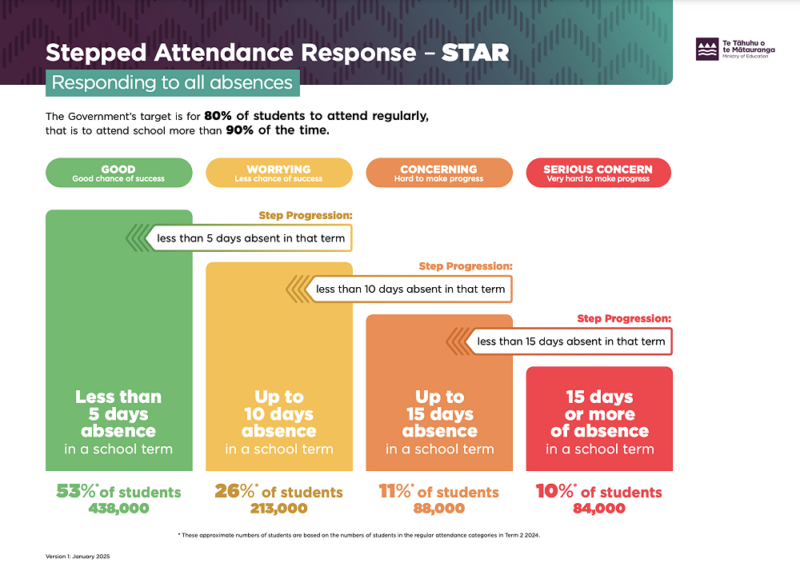
We use a tiered approach to identify and respond to student absences (details in diagram on final page)
| Attendance Category | Definition | School Response |
| Regular Attendance | 90% or more (absent less than 5 days a term) | Tier 1 – Universal Support:
• Acknowledged and celebrated through class and school-wide recognition. • Teachers maintain positive communication with whānau. |
| Irregular Attendance | 80%-89% (absent 5-9.5 days a term | Tier 2 – Targeted Support:
• Tier 2 Letter to Parents/Caregivers + Why Attendance Matters info sheet. • The teacher contacts whānau to understand the reasons for absence. • The school offers support to address any emerging barriers (e.g., transport, uniform). • Attendance is monitored closely for improvement. |
| Moderate Absence | 70%-79% (absent 10- 14.5 days a term) | Tier 3 – Intensive Support:
• Tier 3 Letter to Parents/Caregivers + Why Attendance Matters info sheet. • Principal/Senior Leader meets with whānau and students to develop a supportive plan. • The plan may involve connecting the family with community resources. • A formal attendance improvement plan is created, with clear goals and checkins. |
| Chronic Absence | Less than 70% (absent 15 or more days a term) | Tier 4 – Referral:
• Tier 4 Letter to Parents/Caregivers + Why Attendance Matters info sheet. • All previous steps have been documented and a formal referral is made to the Ministry of Education Attendance Service. • The school continues to work closely with the Attendance Service and whānau. |
- Procedures for Absence Notification and Follow-up
4.1 Daily Attendance Recording
- Teachers will mark the electronic attendance register (or a paper copy should the electronic register be unavailable) for all students by 9.15 am each morning and 1:55 pm each afternoon.
- Attendance will be submitted daily to the Ministry of Education.
- The school is using the refreshed set of attendance codes as required by the Ministry
4.2 First-Day Absence Follow-up
- If a student is marked absent without a prior explanation, the administration staff will contact the student’s primary caregiver via text message by 10:00 am.
- If the caregiver cannot be reached, an email is sent.
- Unexplained absences that remain unresolved by the end of the school day will be coded as ‘T’ (Truancy).
4.3 Absence Notification by Whānau
- Whānau are expected to notify the school of an absence by 9:00am on the day of the absence.
- This can be done via the School App, a phone call to the school office at 09-4256058 or via our school website
4.4 Justified vs. Unjustified Absences
Justified: Medical – M Code; Funeral – J Code; School Trial Day – J Code; Registered One Day School – J Code
Unjustified: Holiday – G Code; Family Visiting – E Code; Non School Sports Events – E Code; Unregistered One Day School – E Code
- Addressing Barriers to Attendance
Recognising the unique challenges of a semi-rural community, we will proactively address common barriers:
- Transport: We will work with whānau to identify transport issues and connect them with available School Bus or Auckland Transport Public Bus routes or transport assistance where possible.
- Community Links: Our school will maintain strong connections with NAISSS, Oranga Tamariki, community groups, and the police youth aid constable. This network provides a valuable resource for supporting families facing complex challenges.
- Kaupapa Māori Approach: We will adopt a culturally responsive approach, ensuring all interactions with whānau are empathetic and uphold mana.
- Addressing ‘Late’ Students
- Students and or caregivers sign in through Vistab in the office with a reason for being late.
- Lateness is reviewed weekly by the Principal and Senior Management Team to identify students with frequent lateness.
- The teacher contacts whānau to understand the reasons for ‘lateness’ and sends Why Attendance Matters info sheet to parents.
- The school offers support to address any emerging barriers.
- Data Monitoring and Plan Review
- Attendance data is reviewed weekly by the Principal and Senior Management Team to identify students in the Irregular and Moderate absence categories.
- The Board receives a termly attendance report.
- This plan will be reviewed annually by the Board in consultation with staff, whānau, and the community.
- In Summary : In line with the government’s target of 80% of students regularly attending school by 2030:
- Our school has set a target of 68% (Regular Attendance) by Term 4, 2026. This target is set out in our school’s Annual Implementation Plan.
- Our Attendance Policy: Regular attendance supports learning, friendships, and wellbeing. Whānau must contact the school early to explain any absence. For extended leave, a request must be sent to the Principal.
- Our Attendance Procedure: We are required to track attendance and report unjustified absences. We follow up quickly on unexplained absences and work with whānau to address any barriers.
- Monitoring and Reporting: Attendance is monitored daily. Weekly data is reviewed by the leadership team, and the Every Day Matters termly report from the MOE is shared with the School Board. Term reports include breakdowns by gender, ethnicity, year level, justified and unjustified reasons, insightful trends and next steps.
- Attendance Services: NAISSS (North Auckland Integrated School Support Service) and other support agencies are used when necessary.
Ministry of Education Guidance:
- The Ministry of Education NZ provides a guide for schools and kura on managing student attendance.
- The Ministry of Education NZ refreshed attendance codes.